Buxtehude Praeludia: A Schenkerian Approach
Of the work done by Schenkerian Theorists, relatively little attention has been given to shedding light on the fugue. The origins of the fugue in the strict contrapuntal world of the late Renaissance and Baroque period give it a structure that works less politely with Schenkerian theory than the forms of later styles. The highly surface-level counterpoint of fugal formulation is often the only dimension in which fugal writing is analyzed, and deeper analyses are usually relegated to specific examples in Bach and the Well-Tempered Clavier. Moreover, Schenker’s own theories cast the music before Bach as merely formative to what would culminate in his tonal system. Much of this early music is formed in a style dependent on imitative counterpoint that more or less culminated in the fugue.
All other music was of lesser quality. Schenker therefore chose to ignore so-called "early" music. It is bypassed in his writings, though he makes reference to its shortcomings and outlines its historical role as preparatory to the masterworks of his domain. (Novack)
This disparity between the music that is “before” or “after” Bach is the biggest challenge in analyzing fugal writing that predates the Major/Minor system or, in fact, writing that post-dates it as well (in the case of the Shostakovich fugues). Furthermore, the version of the fugue which Bach generally creates and which has solidified its place in the minds of theorists is at times a far cry from what more broadly could be considered fugal writing.
With these considerations in mind, on principle, the question of applying a proper Schenkerian analysis to the praeludia of Buxtehude rests on uneasy terrain. However, there is a pedagogical question that the application could answer. This is how Bach came to feature such clear hierarchical practice in his music by examining hierarchical patterns in the music of one of Bach’s teachers, Buxtehude.
It should be stated that although proper Schenkerian theory is questionably applicable to the music “before” Bach, hierarchical structure (which is the basis for Schenkerian theory), can be presumed to be present in much of the music of the Western Tonal System. Some work by Saul Novack, for example, compellingly demonstrates principles of unfolding in Gregorian Chant. The question then becomes to what degree a voice-leading graph is useful in demonstrating interesting or noteworthy structure in the work of Buxtehude and to what degree the structure in Buxtehude is similar to Bach's, and moreover, is there a plausible explanation why Buxtehude or music of a similar variety was omitted from Schenker’s own theories?
The likely culprit for many of Schenker’s other omissions, namely his racism and xenophobia, is a plausible explanation but hard to prove. Though Buxtehude was Danish, nationality, and indeed German nationality was different in meaning at the time, and Buxtehude would come to be known as part of the North German Organ School and ultimately Germanize his name from Diderich to Dietrich. Of course, the notable lack of any other “officially” German counterparts to Buxtehude suggests this was at least not the primary reason.
Among the work that has been done to study the praeludia of Buxtehude, Lawrence Archbold presents the most thorough analysis of the Praeludia taken together in his book “Style and Structure in the Praeludia of Dietrich Buxtehude.” Archbold is a proponent of the idea that the Praeludia, on the whole, exhibit hierarchical structure, and Schenkerian technique can be used to analyze harmonic movement in the music.
Fugal sections are even more tightly organized than modular textures, and the analysis of their harmonic areas is inseparable from that of their fugal form. The alternation of subject and answer produces either a large tonic area (if the subject does not modulate) or an oscillation between tonic and dominant harmonies (if the subject does modulate). The actual progressions which comprise the harmonic areas are as simple or as complex as the harmonization of the subject demands. A diatonic subject (by far the most common) will have a simple progression; a chromatic subject (which is unusual) will have a rich, complex one. After the exposition, fugal sections often continue with more expositions and other added entries in the original key. Episodes are rare. Thus an entire fugal section can be in a tonic harmonic area, or exhibit only an oscillation between tonic and dominant areas. An actual exposition outside the tonic (rather than just one or two entries) is found far less frequently; the mediant is the most likely choice. In this way, harmonic areas other than the tonic or dominant are introduced into fugal sections. (Archbold)
Archbold clearly applies Schenkerian technique more so to passages involving overt pedal point, but his analysis of the harmonic structure of fugal sections in the praeludia points to hierarchical thinking. The clearest evidence for this is the structural harmonic nature of the fugal subjects, and more importantly, each subject's answer, which is often modified to prolong tonic harmony. In these instances, Buxtehude trades small-scale imitative precision for large-scale harmonic progression.
My analysis of a fugal section from the Praeludia in E minor, BuxWV 142, demonstrates this principle. The subject, found in the first fugue section beginning at measure 17, is built on the two structural pitches of the main harmonic area. In fact, the defining motive is altered with each subject and answer to maintain the harmony. The subject begins with an ascending fifth, which is followed by leading tone motion back to the 5th scale degree; the answer begins with an ascending 4th and leading tone motion that leads back to the 1st scale degree. The overall motion of the answer, as shown below, indicates overall motion in both the subject and answer towards the structural pitches of the tonic stufen.
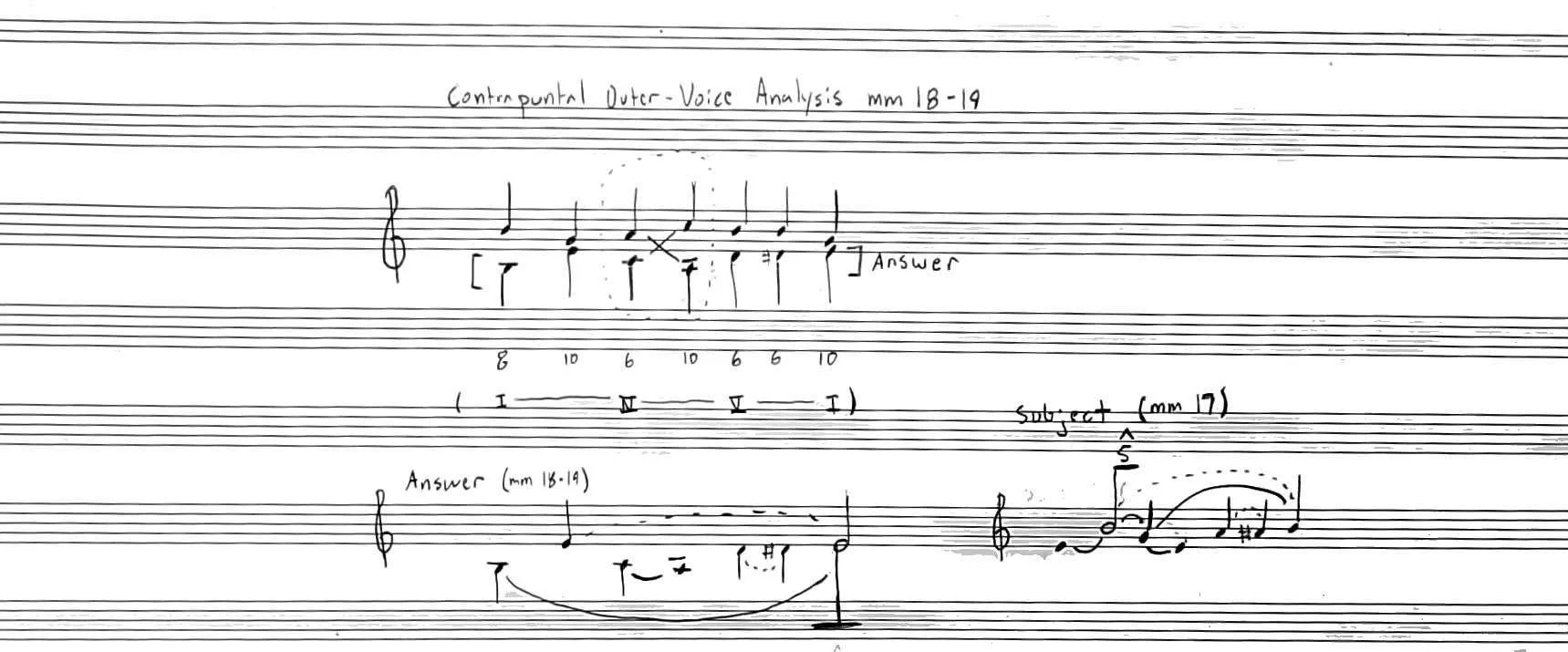
Fig. 1
Among the interesting things in this prelude is the odd phrase rhythm which occurs in this fugue and a later fugue. Instead of the subject and answers occurring on strong hypermetrical beats, they occur in the middle of measures or on the weak beats of a presumed 4-bar hypermeter. William Rothstein’s Schenkerian analysis techniques are closely related to his work regarding hypermeter and phrase rhythm. Rothstein’s process involves developing an “imaginary continuo” as a chordal reduction of the melody and harmony to remove surface-level suspensions. However, this imaginary continuo falters when the harmonic movement of a section does not fit clearly into the written meter, as is the case with this fugal section. This theory is extrapolated into specifically fugal analysis by Sarah Marlowe to an effective extent in fugues by Bach. So rather than look at an individual bar of the written meters, my preference has been to use each entry of the subject (in whatever transposed form it occurs) to determine underlying structure in the fugue.
Upon full analysis, a few levels of structure can be seen. Of course, in this style of music, every note is justifiable through Fuxian counterpoint. But the questions arise as we move past the level of the largest dictated metrical value (quarter notes in this instance). Archbold states that some fugal sections can be seen as either only in the tonic or only oscillating between tonic and dominant areas. However, in this example, the use of the predominant is clearly seen in the final concluding measures of the fugue and even the fugue subject itself (as shown in fig. 1). In fact, in almost every instance of predominant harmony, the harmony does in fact function as a prefix to the dominant. What is different, perhaps, than, say, later styles is that there are numerous returns to the tonic via a Perfect Authentic Cadence. Of course, these cadences are not metrically accented, giving preference to the idea that they are, in fact, “loops” which prolong tonic harmony.
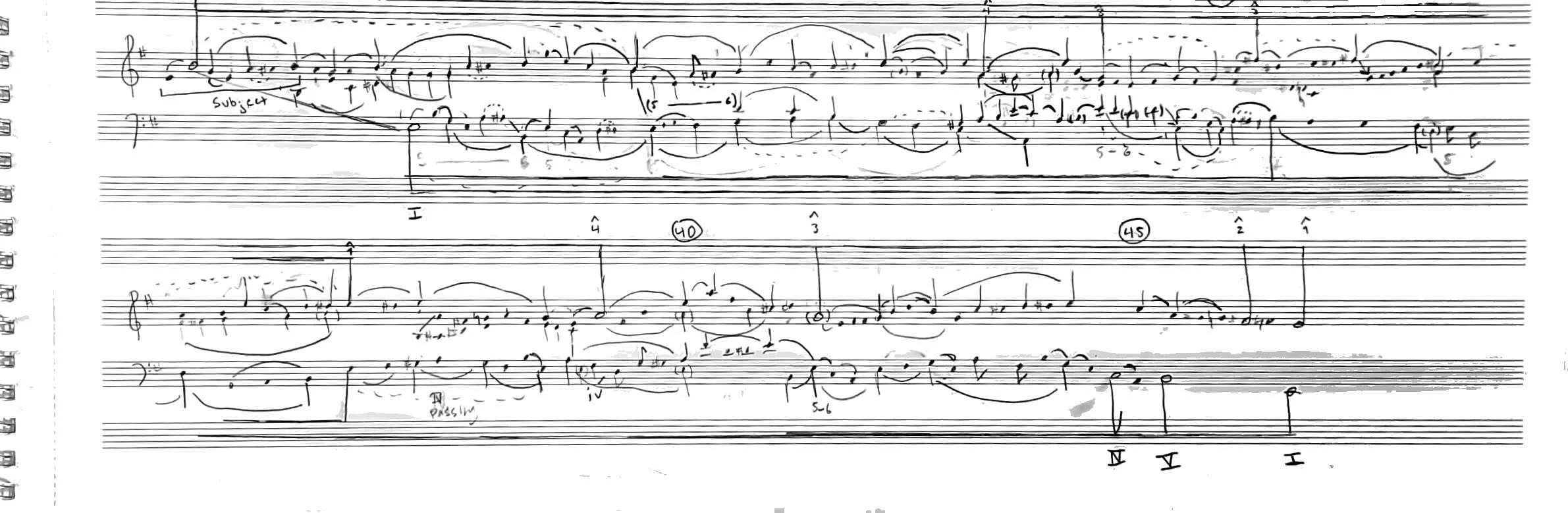
Fig. 2
A further complication with the predominant is how it functions in relation to the dominant. Throughout the fugue, the leading tones are often stated in both their modal and harmonic forms (major V and minor V). Often, though, the V chord is first stated in its modal variation, then inflected up to return to the tonic (the tonic itself is at times inflected to its major form). Archbold describes this phenomenon as a “predominant chain.” Of course, the “chain” nature of this phenomenon makes discerning deeper structure more difficult.
From a historical lens, it is even more interesting to note how Buxtehude may have actually thought of the predominant. Scholarship in Baroque music, specifically contrapuntal music, prefers understanding the predominant as “the other fifth” (Pack). Buxtehude’s use of the IV chord in this way does suggest this way of thinking, but he incidentally inflects the 4th scale degree itself to form a vii°/V. The pattern of doing so is almost more Schoenbergian in its creation. The seed, the very initial statement of the subject, includes this very distinctive inflection of the 4th scale degree as a prefix to dominant harmony, and that characteristic becomes more or less the rule that dictates the use of IV harmony throughout the entire piece.
I only highlight one section in my analysis, which details a sectional emphasis on the IV stufen. This instance occurs in measures 27-29, and I show it as part of a more surface-level structural occurrence (see fig. 2).
Beyond this fugue, the entire prelude is organized into clear structural sections, each one with a clear cadence at the end. These cadences can be used to create a background of the entire piece. Because the harmonic rhythm within the sections is generally unclear, and there is no pre-existing form the harmonic areas in this piece conform to, the cadential points are a smoking gun pointing to the main harmonic areas. What is problematic about this approach is how the piece ends. Schenkerian theory attempts to show how all music comes to rest, the ursatz or the more “dissonant” consonances coming to rest at the more consonant unison. In this example, the piece ends with a very clear voice presenting the third. The main upper voice of the last few measures prolongs the 7th of the V harmony over a dominant pedal, and the final motion of the piece is the altizans movement displayed in the most prominent voice (that is, a voice stepping down from fa to mi at a cadential point). This is quite a common cadential pattern in the early Baroque. However, Schenker would be unsatisfied with this ending.
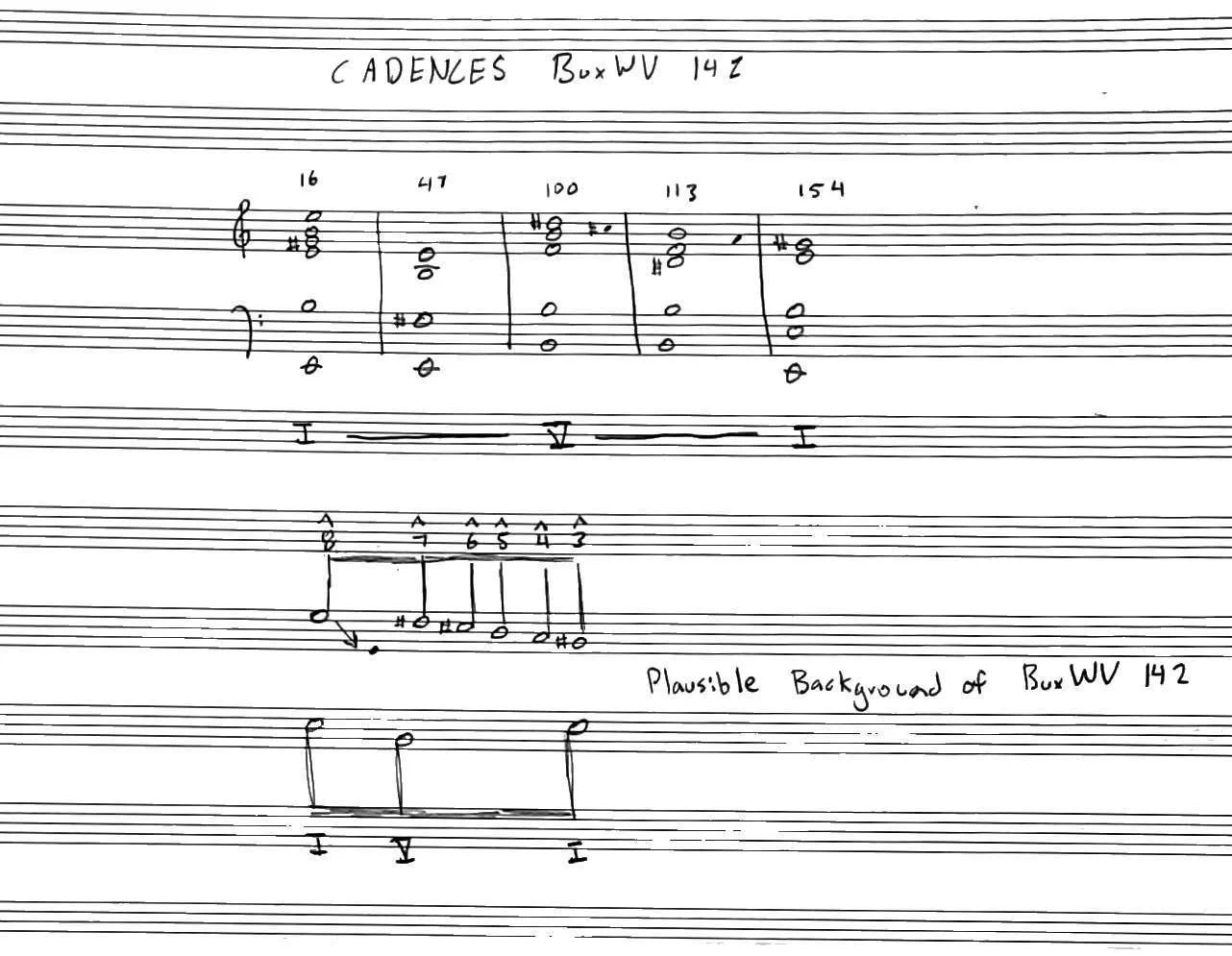
Fig. 3
And perhaps this is why Schenker omitted Buxtehude from his theories. Of course, later theorists examining Bach find similar cadential patterns. For example, Sarah Marlowe in her works on the Schenkerian analysis of Bach fugues, notes a similar occurrence in the Bach fugue in D major from the Well-Tempered Clavier. Her claim is that though the 3rd scale degree is the stated melody, the descending motion is resolved in an inner voice, and the final melody voice ending on the third is the result of parallel 10ths. (see fig. 4). While this is not an implausible explanation for the Buxtehude example, it is more of a stretch to force upon this piece. Least of which is the problem that there is no clear scale degree 2 preceding the final note unless we assume the inner voice resolution comes in the tenor voice of the texture.

Fig. 4 (Marlowe)
Of course, it would be a mistake to say that simply because a piece of music does not integrate fully with Schenkerian theory, Schenkerian theory is not a useful tool to analyze that piece. In fact, much of the work Drew Nobile does deals with the application of Schenkerian technique to popular music. His ultimate conclusion is that there are subsequent rules which explain apparent “problems” within Schenkerian graphs (like chord loops or the melodic-harmonic divorce), but also that Schenkerian theory can show deeper structure which justifies surface-level “counterpoint errors.”
In this music, however, the question is more focused on the deeper level. There are no surface-level counterpoint errors that are dismissed by deeper examination, and there are no meandering chromatic sections that depart too far from the tonic and can be shown to be justified. In fact, the problem is more so how to show deeper structure that isn’t just tonic prolongation (even attempting to define dominant prolongation required by my background sketch in Fig. 3 is a stretch, as much of the music following the dominant cadential points returns to tonic). So then, it may be valuable to show how all of these ideas are connected, but in reality, the goal of the music is to overtly show these things. It could be thought that Buxtehude seeks to create expansive regions of music which do not depart from the tonic area. This is especially clear in BuxWV 142’s phrase rhythm which at all costs avoids putting cadential movement on hypermetrical downbeats so that it is constantly “floating.” This is a through-line of almost all the praeludia. Bach moves us in a new direction following this, where whole episodes will depart and exist in their own separate key, and here Schenkerian theory can show us how those episodes relate to the Ursatz. It is not necessarily that Schenkerian theory omits the work of Buxtehude and similar composers because it is so “formative” to subsequent music, but because the music of Buxtehude has a different focus and Schenkerian theory does not illuminate much in regard to that focus.
Bibliography
Archbold, Lawrence. Style and Structure in the Praeludia of Dietrich Buxtehude. Studies in Musicology 82. Ann Arbor, MI: UMI Research Press, 1985.
Marlowe, Sarah. “Schenkerian Analysis of Fugue: A Practical Demonstration.” Journal of Music Theory Pedagogy 33 (2019): 119–176. https://doi.org/10.71156/2994-7073.1204
Novack, Saul. “The Analysis of Pre-Baroque Music.” In Aspects of Schenkerian Theory, edited by David Beach, 95–113. New Haven, CT: Yale University Press, 1983.
Nobile, Drew F. “Counterpoint in Rock Music: Unpacking the ‘Melodic-Harmonic Divorce.’” Music Theory Spectrum 37, no. 2 (2015): 189–203. https://doi.org/10.1093/mts/mtv019
Rothstein, William. Phrase Rhythm in Tonal Music. New York: Schirmer Books, 1989.
